

How to protect more Australian homes from the growing risks of floods, fires and other climate disasters

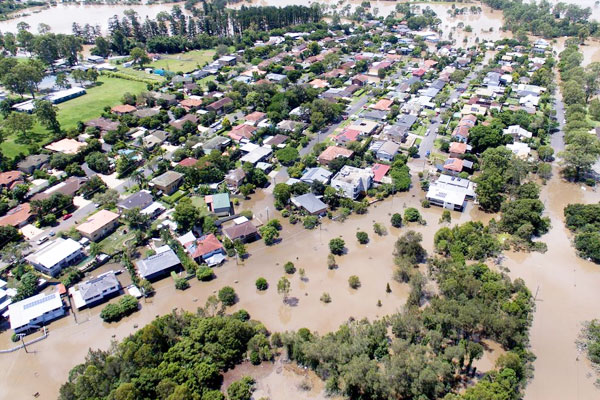
The cleanup is underway in northern Queensland following the latest flooding catastrophe to hit the state.
More than 7,000 insurance claims have already been lodged, most of them for inundated homes and other structures.
The Queensland floods are a reminder that climate-induced natural disasters are becoming more frequent and severe in Australia.
Recent reports have identified a high number of Australian homes that are vulnerable to the increased risks of floods, coastal erosion and bushfires.
Despite the evidence of escalating danger to homes and communities, we are ill-prepared for severe weather events.
A new report from the Australian Housing and Urban Research Institute spells out the case for better integration, especially of urban planning processes.
This is urgently needed to reduce the exposure of housing to growing disaster risks.
Top priorities for planning authorities must include an end to building homes in the wrong locations, such as flood zones and improving the resilience of dwellings to disaster hazards.

Poor coordination
At the national level, there is little integration of the three pillars of sound strategy: housing policy, settlement planning and disaster management.
For example, neither housing policy nor planning frameworks incorporate disaster preparedness or mitigation.
A focus on disaster response and recovery also hinders proper coordination in the disaster prevention area, even though avoidance in the first place is clearly more cost-effective.
However, this may be changing.
Both the Issues Paper for the National Housing and Homelessness Plan and State of the Housing System report have acknowledged climate change and natural disasters are risk factors affecting housing.
And the National Urban Policy includes “sustainable and resilient” as one of its three major goals for liveable cities.
At the state and territory level, there is more clearly defined coordination through state emergency management planning.
It also occurs via fire agencies that advise on planning proposals.
In New South Wales, the NSW Reconstruction Authority is responsible for developing and implementing the State Disaster Mitigation Plan and for housing recovery.
This means settlement planning and relevant housing issues are directly under the auspices of the agency responsible for disaster prevention and recovery.
This is one way to improve integration, but further coordination with housing and planning agencies would be desirable.
Greater focus on risk reduction
Relevant Australian agencies are enhancing their approaches to disaster management in relation to housing.
But housing policy still needs to accord greater priority to disaster risk reduction.
This includes the location and resilience of housing relative to climate change hazards, such as fires and floods.
In settlement planning, tensions between disaster risk reduction and economic and other development goals need to be addressed.
Planning processes and policies to move communities away from risk areas via managed retreat and possibly compensation schemes must be developed.
We can look to international experience for guidance.
In Quebec, Canada the provincial government offered significant funding towards property buybacks after floods in 2017 and 2019.
It also introduced a cap on disaster aid in high-risk locations.
Bylaw regulations banned any new developments or reconstruction.
Households had to decide to either relocate or bear the cost of repeated disaster recovery.
This strategy is an example of a successful relocation plan in an area at risk of repeated future flooding.
The strategy received a relatively positive response from the affected municipalities and homeowners, potentially due to the generous buyout offers.
This example illustrates the need for policies to manage disaster risk and urban development much more clearly.
Better integration needed
A whole government approach that establishes clear policy and planning responsibilities would improve integration.
It would also allow agencies to develop clearer strategies for the task.
Improved data availability and harmonisation of risk identification would further support good decision-making by housing and planning agencies.
At the operational level, more staff exchanges between housing, planning, and emergency agencies would support capacity building.
Detailed evaluations of housing experiences and planning outcomes from previous disasters would underpin improvements and integration.
This occurs to some extent through formal statutory inquiries into disasters.
A standardised evaluation for housing and planning agencies would provide more focused insights.
One idea is to gauge temporary housing programs to build an inventory of suitable and available temporary housing types.
In addition to coordination between government agencies, there is also a need to better communicate with the public on potential disaster risks.
Local communities need to be included in planning, both for short-term disaster management and longer-term resettlement decisions.
If we fail to better integrate housing policy with disaster preparation, we will continue to build on flood plains and other high-risk areas.
People, and their homes, will remain on the front line of deadly natural disasters.
Guest authors are Annette Kroen, Research Fellow Planning and Transport, RMIT University and Jago Dodson, Professor of Urban Policy and Director, Urban Futures Enabling Impact Platform, RMIT University
This article is republished from The Conversation under a Creative Commons license. Read the original article here.