
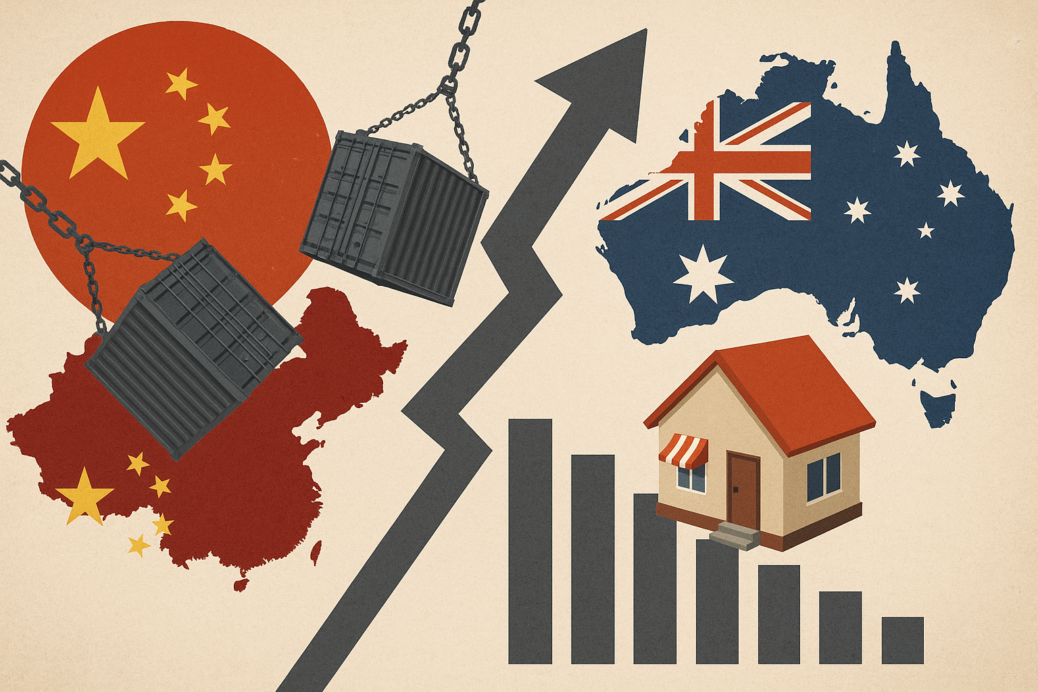


Key takeaways
Trade tensions, especially sparked by Trump’s tariff policies, create economic uncertainty.
Experienced investors know uncertainty can hide significant investment opportunities.
China’s strategy shift from infrastructure to domestic consumption reduces demand for Australian commodities (e.g., iron ore, coal).
Reduced export demand from Australia could push the RBA into multiple interest rate cuts to support the economy.
Melbourne currently lags Sydney significantly in property prices—historically these gaps eventually close.
Strong fundamentals like robust population growth, job creation in the service sector, and constrained housing supply position Melbourne for a catch-up rally in property prices.
Economic downturns don’t necessarily equate to property downturns, particularly if unemployment increases trigger rate cuts.
Historically, Australia’s property markets have often remained stable or risen during economic stress when supported by significant rate cuts.
Trade wars.
Tumbling share markets.
Recession fears.
The news is full of red flags, but experienced investors know that opportunity often hides behind uncertainty.
And this time, the catalyst for the next move in Australia’s housing market might just be found in Donald Trump’s latest tariff tantrums.
They might just set the stage for the next property boom in Australia.
Sounds odd?
Bear with me – there’s a clear logic.
A Global Trade War is brewing again
Trump can’t stay out of the headlines, particularly recently when he announced a sweeping round of tariffs targeting Chinese goods.
Now, Trump has stepped back a little and created some exemptions and delays, but overall, it’s the most aggressive protectionist move since the original trade tensions during his first term.
In retaliation, China has introduced reciprocal tariffs.
It’s already slapped duties on US pork and grain exports, but the real story is in what’s coming: Beijing could move to choke off access to rare earths or American agricultural commodities.
This tit-for-tat response has rattled global markets.
In response, the Dow Jones plummeted, and stock markets around the world followed.
Investors are bracing for slower global growth, and they’re not wrong to be nervous.
But here’s where it gets interesting for us in Australia.
China’s slowdown = Aussie interest rate cuts?
The biggest impact of the trade war won’t be tariffs themselves – it will be the unnerving effect on China’s economy.
Before all this started, China was showing signs of slowing growth.
And unlike previous cycles, when they boosted infrastructure spending (great news for Australia’s iron ore and coal); this time the Chinese Communist Party is shifting strategy.
They’re pivoting to boost domestic consumption instead of building new roads and bridges.
That means less demand for Aussie exports, particularly from mining-reliant states like WA and Queensland.
And if that slowdown trickles into our own economic numbers, the RBA could be backed into a corner.
In fact, the money markets are already pricing in a potential 0.5% rate cut in May, not the typical 0.25%.
And they expect a further 2 to 3 rate cuts over the next year, and for property investors, this could be the trigger that could change everything.
Lower interest rates could unleash buyer demand
Here’s something most people forget – in general, Australia runs on variable interest rates.
That means every time the RBA moves, the impact on the housing market is immediate and widespread.
It’s not like the US, where most borrowers are locked into long-term fixed rates.
In Australia, a rate cut of 0.5% could increase borrowing power by 10–15% overnight.
And we’ve seen time and time again that this kind of policy move brings buyers off the sidelines.
However, different markets react differently, and in the past, when interest rates dropped, higher-priced suburbs tended to react the fastest.
Rate cuts correlated strongly with house price rises, particularly in top-tier markets like Sydney and Melbourne.
The case for Melbourne outperformance
Let’s talk about Melbourne for a moment.
It’s been lagging behind Sydney for a few years now, and the price gap between the two cities has blown out to be the largest differential in decades, and as any experienced investor knows, these gaps don’t last forever.
Melbourne’s fundamentals remain strong: population growth, job creation in services, and a tight housing supply.
If we get those rate cuts, it’s not hard to imagine a catch-up rally in inner and middle-ring Melbourne.

Even a recession might not derail property
You might be wondering – what about the looming recession risk?
Here’s the thing: unemployment doesn’t always kill housing markets.
Why? Because the RBA tends to respond to economic pain with swift interest rate cuts.
And it’s those cuts, not the unemployment rate itself, that drive buyer behaviour.
Historically, we’ve seen property prices hold firm (or even rise) during periods of economic stress, especially when rates are slashed to support households.
Australia’s housing supply crisis adds more pressure
Let’s not ignore the elephant in the room — our housing shortage.
With building approvals at near record lows, and immigration still strong, we’re simply not building fast enough to keep up with demand.
That puts upward pressure on rents and prices, especially in tightly held areas.
And if buyers suddenly have more borrowing capacity due to rate cuts, expect bidding wars to heat up again.
Final Thoughts: The Trade War could trigger a property boom
While the headlines scream “trade war”, smart investors should be paying attention to the second-order effects:
- A weaker China could slow down our exports.
- That leads to interest rate cuts to support growth.
- Lower rates fuel property price growth, especially in undersupplied, in-demand areas.
So ironically, Trump’s tariffs which are meant to protect American industries could set off a chain reaction that supercharges Australia’s housing markets.
And once again, investors who stay informed, nimble, and focused on will be the ones who benefit the most.


