

Setting the right budget for a property purchase, be it a home or investment, is a very important financial decision.
If your budget is too conservative, you risk missing out on potential capital growth or settling for a property that does not meet all your lifestyle needs.
On the other hand, if you overspend and overborrow, you might limit your ability to invest in other assets and/or face financial strain.
Finding that perfect balance is key to making the wisest investment decision.
Break this decision down into two questions
To set a property budget, you need the answer to two questions: (1) How much can you borrow? and (2) How much should you borrow?
The first question, “How much can you borrow?” is determined by your borrowing capacity, which is set by lenders.
A good mortgage broker can help you answer this, as borrowing capacity can vary significantly between lenders based on your individual circumstances.
The second question, “How much should you borrow?” depends on your financial position, cash flow, plans, and risk tolerance.
In the past, the answer to the first question was almost always higher than the second, as banks would typically lend more than what most people were comfortable borrowing.
However, since credit policies have tightened a lot since 2017, it’s become more common for clients to be able to prudently afford to borrow more than what the banks are willing to lend them.
How much should you borrow?
Of course, it’s essential not to borrow more than you can afford.
Just because a bank is willing to lend you a certain amount, does not mean it’s necessarily safe to borrow that amount.
To determine what you can afford, you need to calculate your surplus investable cash flow – essentially, your income minus your expenses.
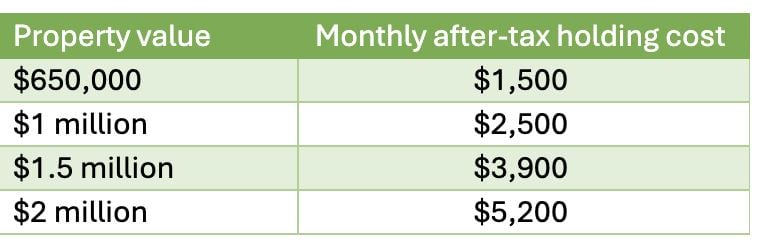
Then, using the assumptions below, you can reverse-engineer the numbers to figure out how much you can reasonably spend on a property.
Conservative assumptions:
- Gross rental yield: 2% to 3.5% (depending on property type and value)
- Minus: 30% of gross rental income allocated for expenses
- Minus: loan interest: 6% p.a. on a loan amount equal to 108% of the property’s value to account for acquisition costs
- Add back: tax savings at 32%, 39%, or 47%, depending on your tax bracket
This table sets out some examples:
Limited by your borrowing capacity?
If your ability to purchase property is constrained by borrowing capacity, there are several steps you can take to address this.
Get a second opinion
It’s important to explore all possible avenues to increase your borrowing capacity.
Getting a second or third opinion from a mortgage broker can be valuable, as they might suggest a different lender or a new way to structure the deal for a better outcome.
Just ensure you are working with reputable professionals.
Never follow advice that encourages withholding information or misleading a lender because ultimately, you are the one signing the application and could be held liable.
Is your borrowing capacity likely to improve in the next few years?
If getting a second opinion does not help, determine whether your borrowing capacity is likely to improve in the next few years.
Borrowing capacity is made up of two key measures: serviceability and security.
Serviceability refers to your income and expenses, while security relates to the assets you can offer as collateral.
Which factor is limiting you; serviceability or security?
If serviceability is the issue, consider whether it will improve, perhaps due to an increase in income or a reduction in expenses/commitments.
If security is the limitation, waiting 6 to 12 months for more comparable sales might result in a higher property valuation, improving your capacity. Or maybe get another bank to value your property/s.
If your borrowing capacity is tight, should you even invest in property?
If your current borrowing capacity is not enough to buy an investment-grade property, and there’s little chance it will improve in the next few years, it might be time to explore other investment options.
For example, if you can’t borrow enough for property, a regular gearing strategy into shares could be a viable alternative.
However, please be cautious about taking on significant gearing in the current market, especially with share indexes near all-time highs.
Should you borrow to your full capacity?
For example, if you can borrow to invest up to $2 million into an investment property, should you invest to this full capacity?
The answer will depend on your personal situation, but I hope the following thoughts and observations can help guide your decision.
Quality over quantity
I firmly believe that investing in the highest quality property your budget allows reduces investment risk and is likely to deliver the best long-term returns.
A high-quality asset is one that benefits from scarcity and consistently benefits from strong demand from multiple sources.
It’s not just about a property being valuable – it’s about it being highly sought after (fixed and limited supply and a lot of buyer demand), like a pink or red diamond.
Personally, if I had a budget of $2 to $3 million, I would focus on investing in one exceptional property rather than spreading the investment across multiple properties.
A home can be a good investment
Many people aim to minimise the budget for their homes to free up funds for investment.
However, this can be a false economy.
Sometimes, the smartest decision is to allocate a larger budget to your home to benefit from its capital growth potential, as explained in this blog.
Time horizon
If you are many years or even decades away from retirement, it’s more appropriate to gear more aggressively.
Looking back on my 30+ years of investing in property, I think I could be in a stronger position today if I had borrowed more aggressively earlier on.
I’m not suggesting you borrow more than you can afford, but I do believe that people in their 20s, 30s, and 40s should avoid being too conservative with their borrowing, especially when they are a long way from retirement.
Other investments
The amount you invest in property should be influenced by your age and other investments.
For instance, if you are young and just starting to build wealth, it’s not a problem if your only material investment is in property.
However, if you are in your 40s or 50s and have a relatively low super balance, I would usually recommend setting a property investment budget that allows you to maximise super contributions, whilst still investing in property.
Or if you have substantial surplus cash flow, I typically aim to diversify investments across various assets and ownership structures, by investing in high-quality property, plus regular share investing in a family trust or company, whilst also maximising super contributions, for example.
The goal is that by the time you reach retirement, it is wise to have your wealth invested across shares and property, whilst maximising the tax benefits of super, as explained in this blog.
Budget first, property second
A common mistake I have observed over the years is when investors choose a location first and then set their budget based on that.
However, I believe a better approach is to set your budget first, and then determine the best type of property and location for that budget.
This ensures you are selecting the right asset that aligns with your strategy, not building a strategy around assets.
Your strategy should always come before the asset.
Don’t ask your barber if you need a haircut
If you ask a buyer’s agent who specialises in purchasing property in regional locations with an average price of around $700,000 what you should do with your $3 million investment budget, what do you think their answer would be?
Be careful who you seek advice from.
It’s essential to do your own research and seek independent advice, though I know that can be challenging, as many financial advisors have limited knowledge about direct property investments.