
Failure is more common than success for young biotechnology companies attempting to get a new drug onto the market. Drug development is rife with pitfalls, from disappointing clinical trial results to funding woes that can end a program prematurely.
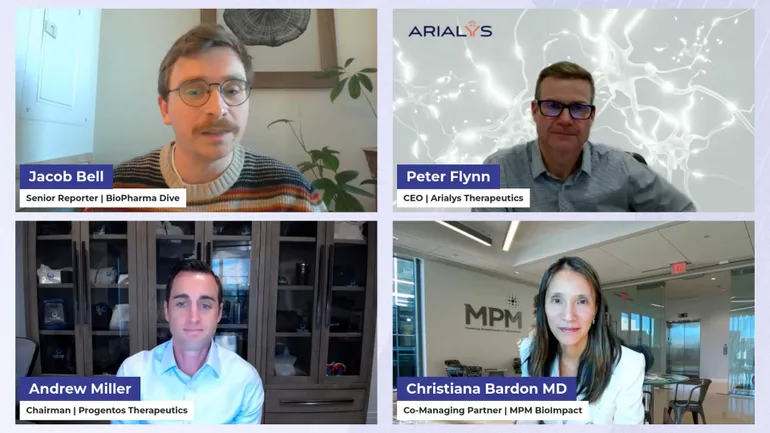
Companies should seek an edge by reducing risk, setting their would-be products apart and communicating clearly with investors on when their bet may pay off, three biotech veterans said during a panel hosted by BioPharma Dive on Nov. 13.
“We need to [have] an eye to a product or a drug relatively quickly,” said Chris Bardon, co-managing partner of life science investment firm MPM BioImpact. “And we need to see that we can again have some good confirmation along the way.”
She added that “discipline and spending” are essential to steady biotech business. “When you see a private company spending $200 million-plus a year, it’s really difficult for them and their investors to actually make money.”
Here are three lessons Bardon and her co-panelists shared:
Accelerating to the clinic
Identifying drug candidates and preparing them for human testing is a risky and time-consuming part of drug development. Any way to shorten that stage can help, panelists said.
In the case of Arialys Therapeutics, which was founded to develop a drug to treat neuropsychiatric disorders, the company acquired a drug that was discovered by Astellas Pharma and had already taken steps toward the clinic.
“What that means is that that first $20 to $30 million worth of work had taken place, and there’d been a level of validation which allows you to accelerate quicker and with more confidence,” said Arialys CEO Peter Flynn. “Just starting from, let’s say, an academic observation today would be really challenging,”
That’s not a strategy that works in every area of drug development, however, said Andrew Miller, chairman of Progentos Therapeutics and founder of Karuna Therapeutics, a schizophrenia drug developer acquired for $14 billion last year by Bristol Myers Squibb.
“It’d be pretty hard for me to tell you a story about how there’s a novel immuno-oncology asset that’s been through Phase 1 that no one knows about and no one has ever talked about,” Miller said.
“But in emerging areas,” he added, “it’s much more likely that there are opportunities that are maybe a little more clear, but are less picked over and just require someone with the right sort of thought process and investigation to go and find.”
Standing out in a crowd
Young biotechs also need to be able to show how they will separate from their competitors, panelists said.
“It might be theoretical right now, but there’s an experiment someday that’s going to tell you how differentiated you are,” Miller said. “So if that’s a real value driver, and that’s something you need to go towards.”
With increasing knowledge around the genetic sources of disease, particularly in areas like neurology and psychiatry, new companies can be built, Bardon said. “We’re seeing many examples of that right now, for example, in Alzheimer’s disease or in ALS, where you’re looking at genetic subcomponents, you hit the genetic subcomponent to prove that it works, hoping that you might be able to go into a broader market,” she said.
But advantages don’t just come from in-the-weeds genetic analyses, Flynn said. “Find any advantage into your approach, your mechanism, your speed of delivery of clinical data, or actual clinical execution,” he said. “It could be something as seemingly simple as [chemistry, manufacturing and controls] readiness for later stage studies or accelerated approval.”
Drugs, not platforms
Drugmaking platforms can hold a lot of allure, promising the potential to build entire pipelines from a single technology. But it’s not always a story that resonates with investors, the panelists said, particularly after a market downturn.
“If you have an asset, then you have an advantage, because then you’re defining the path of the asset, as opposed to, ‘I have a widget to make an asset,’ which is more challenging,” Flynn said.
“How much time and money do you spend investing in the platform, and at what point do you kind of lock on that iteration and move it forward?” Bardon said. “We’ve seen many companies just iterate indefinitely without ever making progress toward an actual drug candidate. That’s not good for the company, that’s not good for the investors.”
And as platform-based companies generate clinical-stage drugs, it can be “a huge sink on company energy to have a large pump,” Flynn said. “So be careful what you wish for from the point of view of building a large pipeline, because it does create downstream stress to the organization.”
Still, Bardon acknowledged that some of the recent innovation in neurological diseases has emerged from drug development platforms. “Some of the most exciting stuff that’s happening in neurology is related to antisense,” she said. “Antisense is kind of old nowadays, but, we’ve figured out the right modifications so that we can maybe cross the blood-brain barrier and distribute throughout the central nervous system broadly.
“I still want my cake and want to eat it, too: I want a platform, and I want multiple drugs,” she said.
Editor’s note: BioPharma Dive hosted the panel discussions mentioned on Nov. 13, 2024. You can register to watch a replay here.