

Key takeaways
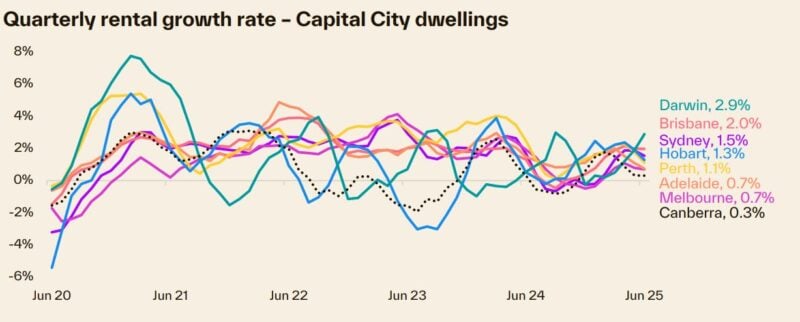
National rental values saw their lowest second quarter increase since 2020 in the three months to June – up by 1.3%.
Over the past five years, rents have increased by 42.7% nationally, taking the median weekly rental value almost $200 higher to $665 per week. Annualised out, this is equivalent to an additional $10,350 per year, spent on rent.
Pre-tax income directed to rental payments rose from around 26% in June 2020 to just under 33% in December 2024.
Sydney maintained its position as the country’s most expensive rental capital in June, with a median weekly rental value of $796 – followed by Perth ($721) and Brisbane ($687).
The regions continued to deliver stronger rental growth compared to the capitals.
National rental values saw their lowest second quarter increase since 2020 in the three months to June, according to Cotality’s latest Quarterly Rental Review.
After shifting higher through the seasonally busy first quarter (1.7%), the rolling quarterly change in national rental values is once again trending lower, with rents up 1.3% over the three months to June 2025.
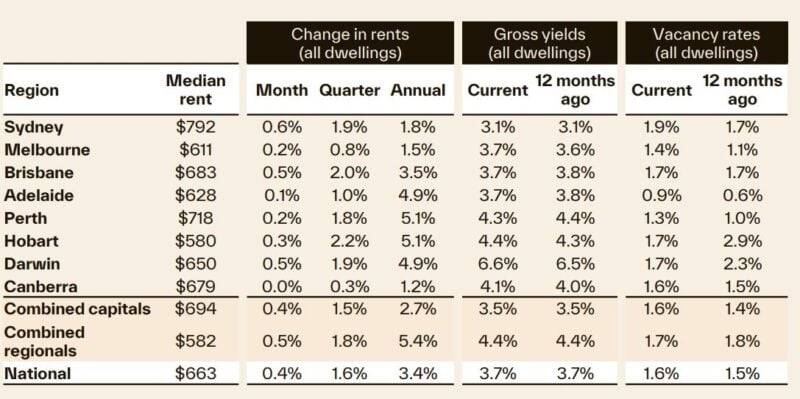
A similar easing was also seen in the annual rental trend, with national rents rising 3.4% over the 2024-25 financial year — the lowest yearly increase since the 12 months to February 2021 (3.0%).
At the median level, that is equivalent to a $22 per week or $1,134 per year increase in rents.
The recent moderation in rent growth has occurred despite available rental supply remaining exceptionally low.
Over the four weeks to June 29, Cotality observed around 100,000 rental listings nationally, roughly 23% below the previous five-year average, or around 29,000 fewer listing than we usually see this time of year.
The shortfall in rental listings has seen the national vacancy rate slip to 1.6% in June, only slightly above the record lows seen in early 2024 (1.5%), and less than half the pre-COVID decade average of 3.3%.
The slowdown in rental growth instead continues to be driven by a tempering in demand, with the normalisation of net overseas migration and a rise in average household size helping to dampen rental demand.
Affordability remains challenging
While the moderation in the pace of rental growth is welcome news to many tenants, rents are still increasing, and affordability remains a key challenge for many.
Over the past five years, rents have increased by 42.7% nationally, taking the median weekly rental value almost $200 higher to $665 per week.
Annualised out, this is equivalent to an additional $10,350 per year, spent on rent.
Considering wages, as measured by the ABS wage price index, are up less than half this rate (15.8%) over the five years to March 2025, it’s no wonder household formation trends are skewing larger as a way of spreading out the additional rental cost.
The disproportionate increases in rents and wages have seen the portion of pre-tax income directed to rental payments rise from around 26% in June 2020 to just under 33% in December 2024.
Across the country
With a median weekly rental value just shy of $800 per week, Sydney maintained its position as the country’s most expensive rental capital in June, with a median weekly rental value of $796.
Perth took out a distant second place with the typical dwelling renting for $721 per week, while Brisbane ($687 per week) overtook Canberra ($677 per week) to claim the third-highest median rent.
The significant changes seen across the leader board in recent years, driven by varied rental conditions.
Just under three years ago, Canberra held the title for the country’s most expensive city to rent in, but weaker growth conditions, and a compositional shift towards units, have seen the national capital land firmly in the middle of the pack.
At the other end of the scale, Hobart remains the only capital with a median weekly rental value under the $600 mark, at $581 per week, while Melbourne maintains its position as the second most affordable rental capital, with the typical dwelling renting for $613 per week.
Smaller capitals and regions deliver stronger rental growth
Looking at growth rates across the country, the combined regions continued to deliver stronger rental growth compared to the capitals, up 1.5% over the quarter and 5.3% over the year, with regional rental growth continuing to be supported by higher rates of net internal migration.
By comparison, the combined capitals recorded a softer 1.3% quarterly and 2.7% annual increase.
Across the individual capitals, Darwin led the pace of annual rental growth, with dwelling rents rising 6.2%, followed by Hobart (5.3%), with both markets seeing an uptick in the pace of rental growth relative to this time last year.
This was followed by Perth (4.9%) and Adelaide (4.7%), with the annual change in rents easing from 13.0% and 8.3% respectively.
While down compared to this time last year (7.5%), at 3.8%, Brisbane’s annual increase in rents has accelerated from a recent low of 3.1% over the three months to February.
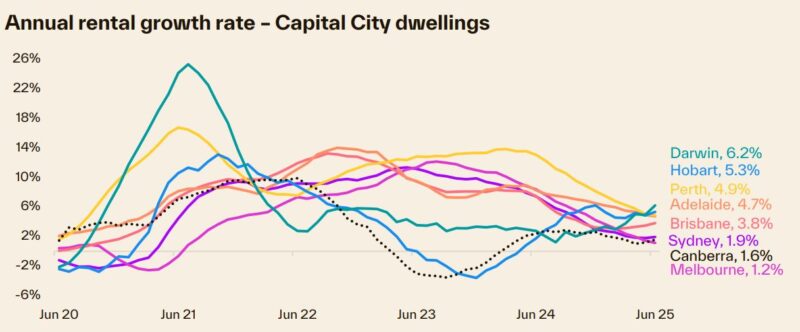
At the other end of the spectrum, change in rents across Melbourne, Canberra and Sydney eased to 1.2%, 1.6% and 1.9% over the year, with all three cities now recording an annual rental rise below their respective pre-COVID averages.