


Key takeaways
Stamp duty is one of the most damaging taxes in Australia, it distorts housing decisions, penalises mobility, and locks people out of home ownership.
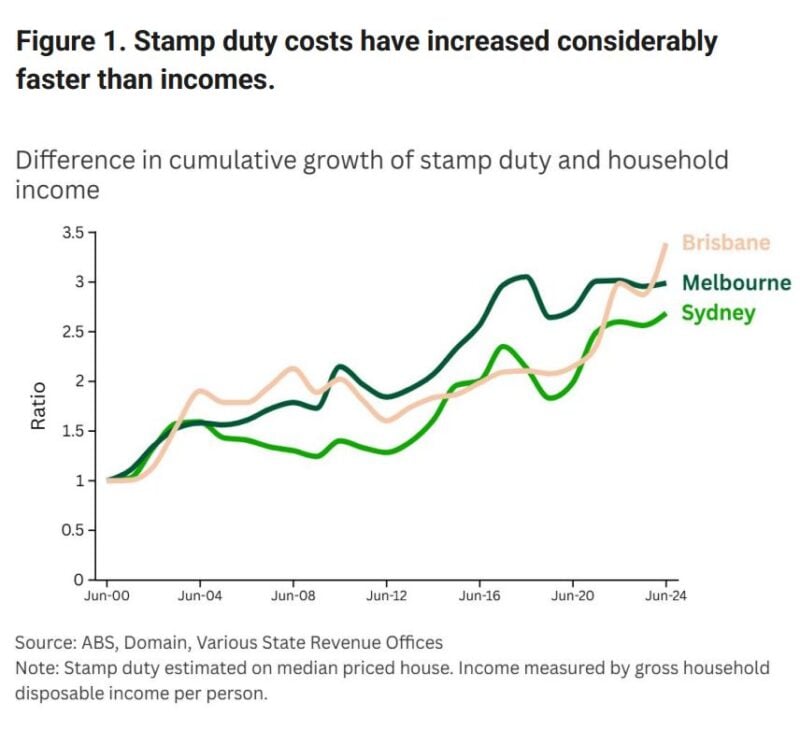
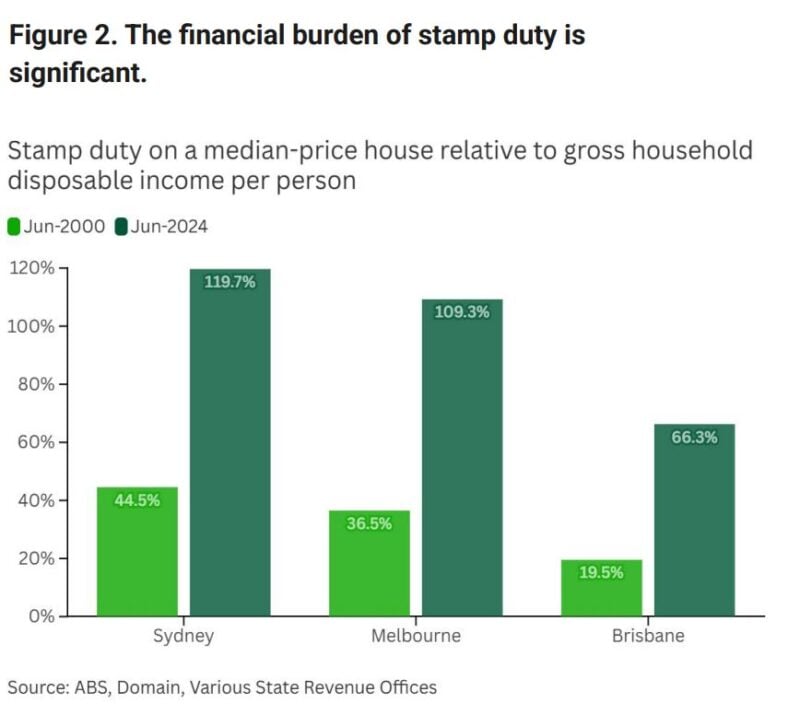
The burden has skyrocketed: In Sydney, stamp duty on a median-priced home rose from 45% of annual income in 2000 to 120% in 2024. Similar trends exist in Melbourne and Brisbane, where stamp duty has grown 2.7–3.4 times faster than incomes.
Australians are staying put longer: The average hold period for houses has stretched from 6 years to 9 years, driven by the high cost of moving.
Replacing stamp duty with a broad-based land tax is one of the clearest reforms available to improve affordability, mobility, and productivity.
For years, stamp duty has been the elephant in the room when we talk about housing affordability and economic reform.
Everyone knows it’s a problem; economists, buyers, sellers, and investors alike.
Yet, despite endless reviews and repeated calls for reform, we’re still stuck with a tax that almost no one is willing to defend.
Dr Nicola Powell, Domain’s Chief of Research and Economics, puts it plainly:
“It’s hard to find an economist who will defend stamp duty. It is one of the most damaging taxes in Australia, distorting housing decisions, penalising mobility, and locking people out of home ownership.”
And she’s right.
If we want to build a more dynamic property market and a stronger economy, stamp duty has to go.
The growing burden on homebuyers
Stamp duty was never meant to be such a massive barrier.
Once upon a time, it was just another upfront cost: annoying, yes, but manageable.
That’s no longer the case.
In Sydney, the stamp duty on a median-priced home has exploded from 45% of annual household income in 2000 to 120% in 2024.
In Melbourne and Brisbane, the story is similar, with stamp duty costs growing 2.7 to 3.4 times faster than incomes since 2000.
Source: Domain
Dr Powell highlights what this means in practice:
“What was once a relatively manageable upfront expense is now a significant barrier, forcing buyers to save for longer and pay more, on top of already steep deposits.”
This growing burden explains why Australians are staying in their homes longer.
The average hold period for houses has stretched from six years in the mid-2000s to around nine years today.
And that stickiness has consequences: fewer downsizers selling, fewer families upgrading, and fewer workers relocating for job opportunities.
Source: Domain
The ripple effects across the economy
Stamp duty doesn’t just hurt individual buyers, it undermines the whole housing market and economy.
According to economic modelling, for every $1 raised in stamp duty, around 70 cents of potential economic activity is lost.
By contrast, raising the same amount via a broad-based land tax costs the economy less than 10 cents.
That’s a staggering inefficiency.
In a recent Domain report, “Why replacing stamp duty with a fairer, more efficient land tax should be top of the Economic Roundtable’s agenda” Dr Powell points out, the impact is far-reaching:
-
It blocks first-home buyers: Stamp duty adds a significant upfront cost, especially for first-home buyers who already face high deposit hurdles.
-
It reduces housing mobility: People stay put rather than moving to be closer to jobs, schools, or family.
-
It exacerbates mismatches: Large homes remain in the hands of downsizers who’d like to move, while families squeeze into smaller dwellings. In fact, research suggests stamp duty deters nearly 25% of potential downsizers.
-
It discourages investment: Buyers are penalised for upgrading or renovating, as improved values mean higher stamp duty on the next move.
-
It weakens productivity: Workers are less likely to move to where their skills are most needed, which drags on both wages and economic growth.
-
It makes state revenues volatile: Because stamp duty is tied to the property cycle, revenues swing wildly, making state budgets less stable.
-
It deepens inequities: It falls hardest on younger Australians and frequent movers, while long-term owners pay nothing more despite huge windfalls in property value.
Put simply, stamp duty locks people into the wrong homes, distorts decision-making, and stifles opportunity.
A case study: the ACT shows it can be done
While most states have shied away from tackling this issue, the ACT has been quietly showing the way forward.
In 2012, the ACT government embarked on a 20-year reform program to gradually phase out stamp duty and replace it with higher annual property rates, essentially a broad-based land tax.
This staged approach has:
And it’s working. The system is fairer, more predictable, and less distortive.
As Dr Powell notes, this kind of model shows what’s possible when governments commit to long-term reform.
By contrast, NSW’s experiment with an “opt-in” system for first-home buyers in 2020 was scrapped in 2023 after a change of government, showing just how fragile piecemeal reforms can be without bipartisan support.
Why national leadership is critical
So, if the ACT has proven it can be done, why haven’t other states followed?
The answer is simple: money and politics.
Dr Powell explains:
“The core barrier is fiscal. Stamp duty delivers large, immediate revenues to state governments, while land tax produces smaller, more predictable flows over time. Bridging that short-term revenue gap is difficult for states to manage alone.”
And she’s right.
States love the sugar hit of billions flowing in during boom times.
But when the property market cools, so do revenues, leaving budget holes.
The solution? Federal leadership.
Canberra could provide transitional funding to help states bridge the gap, while setting up a national framework to ensure consistency.
And let’s not forget the upside: higher labour mobility, better use of our housing stock, and stronger, more predictable government revenues.
Will it push up prices?
Some worry that removing stamp duty might inflate property prices.
But according to the Domain report the evidence suggests the effect would be small.
Yes, lower transaction costs could increase purchasing power, but this would largely be offset by the new annual land tax charges.
In the longer term, the reform could actually help cool certain segments, especially larger homes that downsizers are clinging to purely because selling is too expensive.
By freeing up this stock, we could improve housing efficiency and affordability.
A moment for courage
In my mind, Stamp duty is a relic.
It was designed in a time when property values were modest and when people didn’t need to move around as much for work or lifestyle.
It no longer fits modern Australia.
The upcoming Economic Roundtable is the perfect opportunity for our leaders to show ambition.
If they’re serious about housing affordability and productivity, this is one reform that would make an enormous difference.
The question is no longer if we should replace stamp duty , it’s when.
And the sooner we act, the sooner Australians can enjoy a fairer, more efficient, and more dynamic housing market.