


Key takeaways
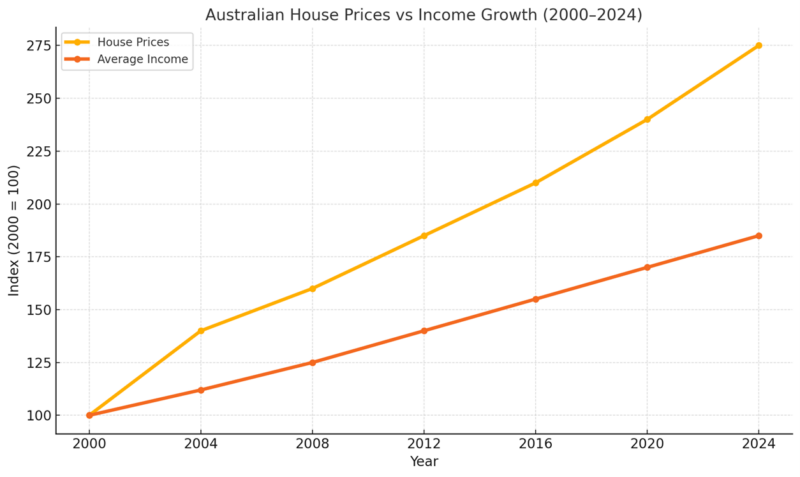
Income growth has stagnated, while asset values—particularly property—have surged.
This has created a tilted playing field, favouring those who already own property or other appreciating assets.
The median home price in Australia has surpassed $1 million, highlighting how far out of reach property is for many Australians, especially younger generations.
If you’re feeling like it’s getting harder to get ahead financially, you’re not imagining things.
While incomes have inched up slowly, property values, and by extension, household wealth, have skyrocketed.
The playing field isn’t just uneven anymore—it’s tilting sharply toward those who already own assets.
You see…in the grand theatre of Australian prosperity, we’ve just witnessed a defining act: According to the ABS, the median Australian home has now cracked the $1 million mark.
Now that’s great news for property owners, but for everyone else, especially first-home buyers and the younger generations, it’s a stark reminder that the ladder to wealth is being pulled further out of reach.
And the truth is, this isn’t just about housing affordability.
It’s about wealth inequality and how owning property is rapidly becoming the great divide in Australian society.
The wealth gap is growing, and fast
Wealth inequality in Australia is accelerating at a pace that should make us all pause.
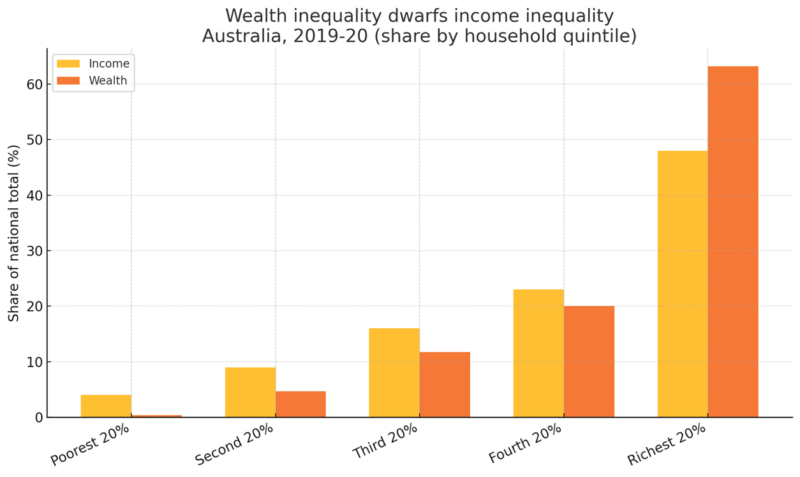
Source: ABS Data
Let’s put things in perspective: the combined wealth of Australia’s 200 richest individuals has ballooned to $667.8 billion, which now makes up a staggering 24.5% of our national GDP.
Two decades ago, that figure sat at just 8%.
[note] That’s not just economic growth—that’s wealth concentration on steroids. [/notes]
At the same time, wealth across Australian households is rising, but not evenly.
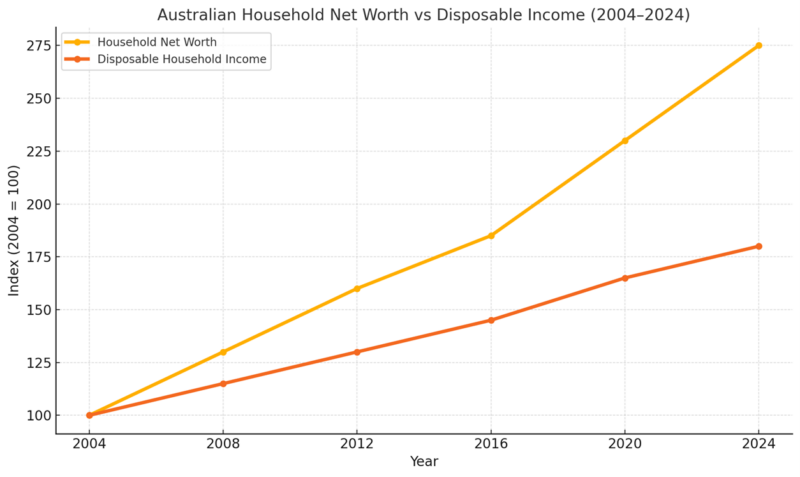
According to ABS data, the net worth of the average household has surged from around $530,000 in 2004 to well over $1.4 million in 2024.
Disposable incomes, by contrast, have grown at a snail’s pace.
What we’re seeing is a divergence: incomes slowly ticking up, while asset prices, particularly residential property, shoot into the stratosphere.
Take a look at the chart below (based on ABS figures), and the pattern becomes painfully obvious:
- Household wealth has nearly tripled over two decades.
- Household disposable income has not even doubled.
That gap? That’s where property lives.
Source: ABS Data
Property: the great wealth accelerator
In Australia, real estate is not just a roof over your head, it’s the foundation of long-term financial security.

Around 55% of Australian household assets are tied up in land and dwellings.
That means most of our wealth growth is tied to the housing market, not wages, not shares, and not savings accounts.
And that’s where the problem lies for those left out.
Those who got into the property market early, baby boomers, Gen X, or even Millennials who scraped into their first homes a decade ago, have benefited immensely from decades of capital growth and leveraged equity.
Meanwhile, those still renting or waiting to “save a bit more” are watching the ladder get taller, faster than they can climb.
This dynamic is what’s driving inequality: those who own property are compounding their wealth, while those who don’t are falling behind.
No, don’t blame this on “ugly, greedy, property investors” because 70% of properties are owned by homeowners, ordinary mums and dads, so it’s really the roof over their head that’s becoming more valuable over time.
A tax system tilted toward the rich
What amplifies this wealth gap is a tax system that, whether intentionally or not, rewards those who already have wealth or own property.
Let’s break it down:
- Capital gains tax discounts reward long-term asset holders (especially those in property). But while a lot is spoken about the benefits investors receive, the biggest capital gain discount is for homeowners who can upgrade their home and do not pay any capital gains tax at all when they sell!
- Negative gearing continues to favour investors and business owners who take a risk with their capital and at times have more expenses than income. By the way.. I think this is a fair advantage that those who take financial risk receive.
- Superannuation tax concessions benefit those Australians who put money aside to secure their financial future in retirement.
[note] What this means is: once you own assets, the system helps you grow and protect that wealth more efficiently than income alone ever could. [/note]
The lesson? Don’t just work for your money, make it work for you
The message here isn’t to vilify the wealthy. Far from it!
What I’m trying to get across is that it’s important to understand our capitalist system, to learn from what’s worked for the wealthy and to understand how to play the game with the rules we have been given.
If you’re not yet a property investor, now is the time to seriously consider becoming one.
This is not about speculation, it’s about strategically using real estate as a tool to build wealth over time.
Because despite all the noise: interest rates, media panic, politics, the fundamentals haven’t changed:
- Australia’s population is growing.
- We have a chronic housing shortage.
- Demand continues to outstrip supply.
- Rising construction costs mean all new dwellings will be considerably more expensive
- And land in our capital cities (which is where most people want to live) is finite.
These are the ingredients that make residential real estate such a powerful long-term asset.

It’s not too late, but it is getting harder
Yes, affordability is an issue. Yes, borrowing capacities are tighter.
But the cost of waiting can be even greater than the cost of entry.
That’s why smart investors aren’t sitting on the sidelines, they’re thinking strategically:
- Buying investment-grade properties in tightly held suburbs
- Leveraging equity to grow a portfolio over time
- Working with property strategists (like our team at Metropole) to build intergenerational wealth.
Because in 10 or 20 years, today’s prices will look like a bargain. And those who acted will be on the right side of the wealth divide.
Wealth in Australia isn’t just growing, it’s compounding.
But only for those who understand that owning property is no longer optional if you want to create a financially secure future.
The data is clear. The opportunity is still there.
Now the question is: will you take action, or keep waiting while others build their wealth?
That’s where our Complimentary Wealth Discovery Session comes in. We’re offering you a 1-on-1 chat with a Metropole Wealth Strategist to help you:
- Clarify your financial goals
- Understand how macro trends affect your position
- Build a personalised, data-driven property strategy
- Get ahead of the curve — before everyone else piles in
There’s no cost, no obligation — just practical, tailored guidance based on decades of experience.
Click here now to book your free Wealth Discovery Session.