
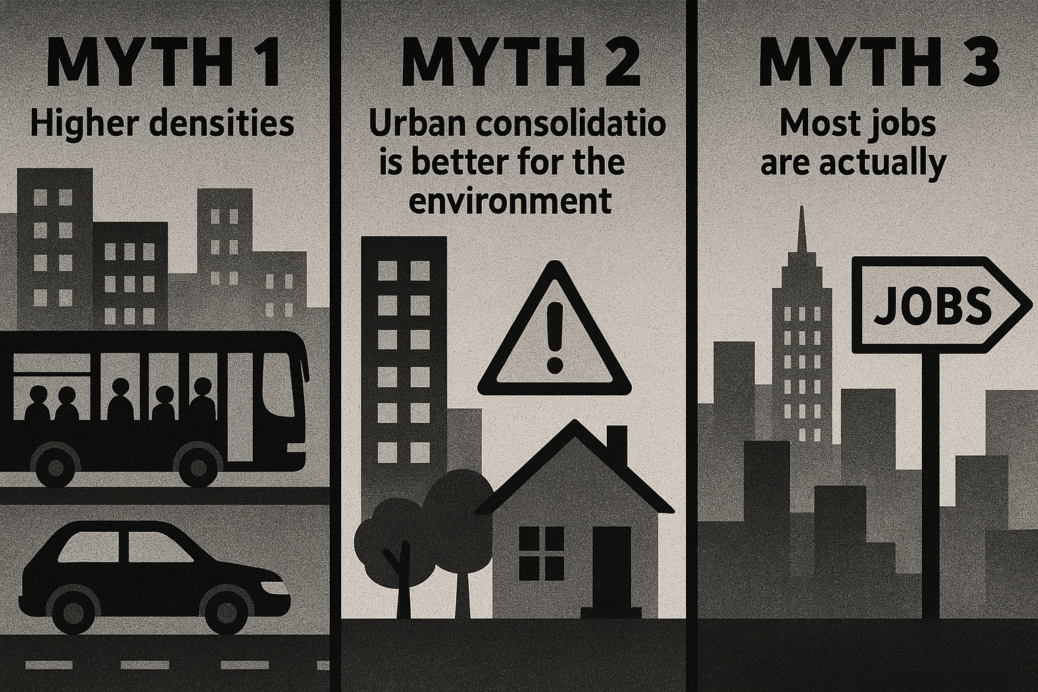

Urban planning in Australia is often built on shaky assumptions.
Myths perpetuate.
This post covers three such urban myths.
Myth 1 – Higher densities mean less traffic
The theory is that higher densities around existing public transport networks will see a lift in public transport use and fewer cars on the road.
Public transport accounts for about 10% of total trips in our major cities and most urban metropolitan strategies aim to increase this to 20%.
So, four-fifths of the trips will, at best, still be via private vehicle.
Why? Because the car is much more convenient.
Without serious infrastructure commitments to repair and upgrade the public transport networks in our cities, cars will continue to dominate.
Under current conditions, and somewhat ironically, inner city and middle-ring residential development is resulting in more traffic congestion.
Myth 2 – Urban consolidation is better for the environment
This implicit assumption is now widespread.
Yet, the available evidence suggests the opposite.
- Comparison between suburban houses and attached product often overlooks the number of persons per household, which is much higher in the traditional suburban detached house.
- In traditional suburban detached homes, larger household numbers share various facilities – the refrigerator; television; washing machine; dishwasher etc., and even the lighting needed to light a room. The per capita energy, and even water consumption, is more efficient in suburbia than in more central urban locations.
- The nature of high density apartments is, in itself, prejudicial to positive environmental outcomes, due to things like clothes driers (lack of outdoor drying areas), air conditioners, lifts and the need to service (lights and air-conditioning) common areas.
- Also, suburban development allows for wider footpaths and private yards, which in turn provide space for trees to grow. There is less opportunity for greenery – a key producer of carbon offsets – in higher density urban development.
- Moreover, the greatest correlation between energy and water use (and hence, environmental impact) is based on per capita income. Wealthy people consume more energy/water and thus have a bigger environmental impact. Only the top 10% can afford a downtown apartment.
- And research by the Australian Conservation Foundation found that in almost all Australian cities, inner city housing produced higher per capita greenhouse emissions and had larger eco footprints than outer suburbs, notwithstanding the greater access to public transport.
Myth 3 – Most jobs are downtown
There is a widespread presumption that central business districts and their immediate fringes contain the majority of jobs in a city’s economy.
Developing housing further from the downtown area, the argument goes, will only mean more congestion as commuters try to get in and out of the downtown area.
It is easy to understand how this myth developed – the CBD/fringe holds the tallest buildings; the seat of government is often located there; so, too, are many cultural facilities; they are the hub of train/tram networks and the focus of much of our angst about traffic congestion.
But the inner city suburbs are home to around 25% of all jobs in a city’s metropolitan area and just 10%, when looking at the CBD alone.
So, 75% of our jobs are actually outside of the downtown area.
The implications of this are profound.
Our elite friends often propose policy based on this myth: that urban dispersal of housing will mean longer commutes to work.
The facts are that most commutes within a city are across suburbs and not downtown.
Unfortunately, this type of travel (and the nature of the work involved) makes it impossible to service efficiently via public transport.
So in truth, more housing on the urban fringe will not, in itself, lead to more inner-city congestion, but will produce more suburb-to-suburb work trips.
End note
Perhaps, as a priority we should:
- Add more vehicular river crossings in a city like Brisbane,
- Create a better ring-road system, and
- Decentralise more of the workforce to suburban and regional locations
…rather than advocating downtown infill redevelopment and heavy inner city-centric infrastructure spending as a cure-all.