
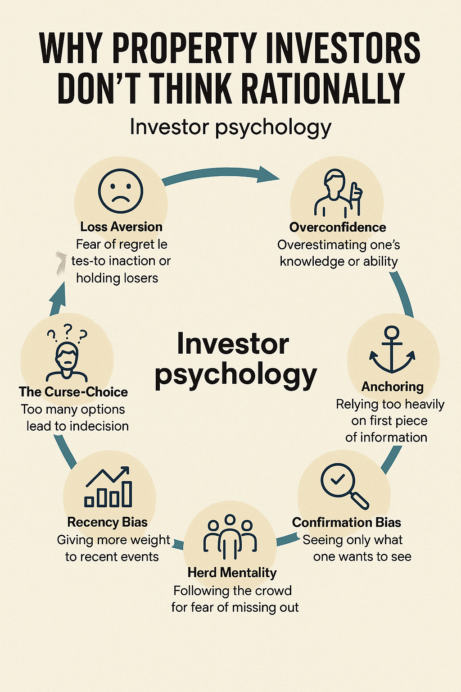
Why Property Investors Don’t Think Rationally — And How Understanding Your Biases Can Make You a Better Investor

Key takeaways
Most investors are not rational — their decisions are driven by fear, emotion, and unconscious biases.
Emotion clouds judgment — and in property, where the stakes are high, that can be especially dangerous.
Successful property investing is as much about mindset as it is about money — self-awareness gives you an edge.
Independent, experienced advice can help override emotional reactions and bring clarity in uncertain markets.
Let me start with a blunt truth: most property investors think they’re rational — but they’re not.
They believe they’re making strategic decisions based on research, market fundamentals, and cold, hard data.
But the reality?
Their decisions are often driven by fear, greed, overconfidence, and a cocktail of subconscious biases they don’t even realise are at play.
This isn’t a criticism — it’s just human nature.
You see… we’re all wired with behavioural biases that made sense in the caveman era but can seriously trip us up in the complex world of investing.
And in property — where emotions run high, stakes are big, and information is often noisy or contradictory — these biases become even more dangerous.
So let’s unpack the major behavioural traps that sabotage property investors (yes, even the smart ones), and talk about how to avoid them.
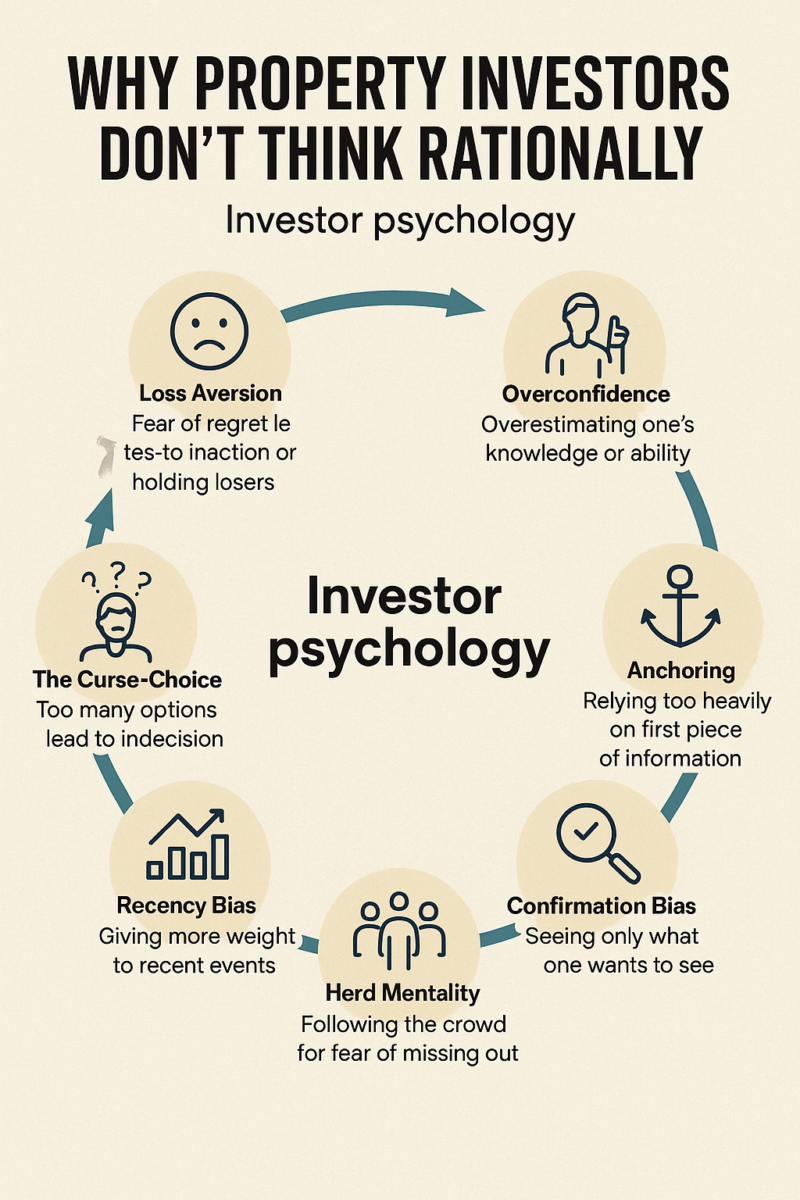
1. Loss Aversion — The Fear of Regret
One of the most powerful biases we carry is loss aversion — we feel the pain of a loss far more than we feel the pleasure of an equivalent gain.
This explains why so many property investors hesitate to sell a dud property — they don’t want to “lock in” the loss.
They’ll say things like, “I’ll wait until it rebounds,” or “It’s only a paper loss,” or “I’m not out pf pocket much.”
Meanwhile, it drags down their portfolio’s performance.
It also causes people to avoid getting into the market in the first place.
Fear of buying the wrong property, or fear of the market dipping after they buy, paralyses them.
The fix? Understand that not every decision will be perfect.
But avoiding action altogether is often more costly in the long run.
2. Overconfidence — Thinking You’re Smarter Than the Market
Ever met someone who bought one property during a boom and now thinks they’re a property guru?
That’s overconfidence bias at work.
It’s the tendency to overestimate our knowledge, skills, or foresight.
In property, this leads to dangerous behaviours — like thinking you don’t need expert advice, ignoring fundamentals, or betting big on speculative areas because “you know it’ll boom”.
The solution? Humility.
Even after 50 years in the game, I’m still learning.
Property investing is simple, but not easy. Always seek data, challenge your assumptions, and lean on independent experienced investment advisors like our team at Metropole.

3. Anchoring — Sticking to the Wrong Reference Point
Anchoring happens when we latch onto a specific piece of information and use it as a reference — even if it’s irrelevant.
For example:
-
“That property was listed for $900K, so anything less must be a bargain.”
-
“I paid $1 million in Sydney, so this $800K house in Brisbane must be cheap.”
-
“My neighbour got $1,200 a week rent — I should too!”
But in property, every suburb, street, and home is unique.
Anchoring to the wrong benchmark can lead to poor investment decisions or unrealistic expectations.
The antidote? Base your decisions on a property’s intrinsic value, growth drivers, and market dynamics — not arbitrary price tags.
4. Confirmation Bias — Seeing Only What You Want to See
Confirmation bias is the tendency to search for, interpret, and remember information in a way that confirms our existing beliefs.
It’s why someone who believes “now’s a terrible time to buy” will only read doom-and-gloom headlines… and ignore every sign of market recovery.
Or why someone who loves a particular suburb will quote every stat that supports their view — while conveniently ignoring the area’s oversupply or demographic challenges.
The fix? Surround yourself with people who challenge your thinking.
At Metropole, we encourage our clients to stress-test their ideas with data and opposing views. It keeps you grounded.
5. The Herd Instinct — FOMO in Action
Humans are social creatures. We assume if everyone is doing something, it must be right.
So when media headlines scream “property prices are booming!” investors rush in — often paying too much or buying in areas already peaking.
During downturns, the opposite happens — people hold back because “no one’s buying right now.”
But that’s often when the best opportunities exist.
Smart investors go against the herd. They’re calm when others panic, and cautious when others get greedy.
As Warren Buffett put it: “Be fearful when others are greedy and greedy when others are fearful.”
6. Hindsight Bias — Thinking You “Knew It All Along”
After a property market cycle plays out, people often say, “It was obvious prices were going to rise in that suburb” — even if they took no action at the time.
Hindsight bias distorts your memory and makes you overestimate your predictive powers.
This leads to overconfidence in the next cycle.
It also fuels unnecessary regret: “I should have bought back then… I missed the boat.”
But guess what? There’s always another opportunity — if you know what to look for.
7. Recency Bias — Assuming the Future Will Be Like the Recent Past
If the market’s been rising, we tend to believe it will keep rising.
If it’s falling, we assume the worst is still to come.
This is why property booms often overshoot (fuelled by irrational exuberance), and downturns last longer than they should (because everyone is too scared to buy).
Recency bias causes people to extrapolate short-term trends indefinitely — a dangerous mistake in a cyclical market like real estate.
Solution? Zoom out.
Look at the long-term fundamentals: population growth, supply constraints, affordability trends, infrastructure investment. These matter far more than short-term blips.
8. The Curse of Choice — Paralysis by Analysis
With so many investment options, suburbs, property types, and strategies, many investors become overwhelmed — and end up doing… nothing.
This is what behavioural economists call “choice paralysis”. It feels safer to stay on the sidelines than risk getting it wrong.
But remember: not making a decision is a decision — and often the most expensive one.
That’s why we believe in having a documented Strategic Property Plan.
It simplifies decision-making by clarifying your goals, timelines, risk profile, and action steps. No more guesswork.

Note: Attaining wealth doesn’t just happen, it’s the result of a well executed plan. Planning is bringing the future into the present so you can do something about it now!
How to Beat These Biases and Invest Smarter
Understanding these biases is the first step. But what can you do about them?
Here’s what I recommend:
1. Have a Plan
A clear, long-term strategy — not reactive decisions based on emotion or headlines — is the key to sustainable wealth through property.
2. Use Independent, Trusted Advisors
At Metropole, we act as an external “brain” for our clients — giving them the unemotional perspective they often can’t give themselves.
3. Don’t Try to Time the Market
Even professionals struggle with market timing. Focus on “time in the market” with quality assets in investment-grade locations.
4. Embrace Education, but Avoid Information Overload
There’s never been more property content online — but much of it is noise. Stick to reputable sources (like the many experts here on Property Update) and avoid jumping from one strategy to another.
5. Reflect, Review, Repeat
Successful investors don’t just “set and forget”.
They review their portfolios, update their plans, and reflect on their decision-making patterns.
Final Thoughts
Property investment is not just about numbers, interest rates, or vacancy rates.
It’s about you, your mindset, your beliefs, your ability to stay calm, rational, and focused when others are panicking or partying.
If you can understand your own psychological tendencies — and put the right systems, strategies, and support in place to override them — you’ll be way ahead of the average investor.
Because the truth is, the biggest threat to your financial future isn’t the market… It’s how you react to it.
If you’re like many property investors, you’re probably wondering what’s the right thing to do at present.
Should you buy, should you sell, or should you just wait?
You can trust the team at Metropole to provide you with direction, guidance, and results.
Whether you’re a beginner or an experienced investor, at times like we are currently experiencing you need an advisor who takes a holistic approach to your wealth creation and that’s exactly what you get from the multi-award-winning team at Metropole.
We help our clients grow, protect and pass on their wealth through a range of services including:
- Strategic property advice – Allow us to build a Strategic Property Plan for you and your family. Planning is bringing the future into the present so you can do something about it now! Click here to learn more
- Buyer’s agency – As Australia’s most trusted buyers’ agents we’ve been involved in over $4Billion worth of transactions creating wealth for our clients and we can do the same for you. Our on the ground teams in Melbourne, Sydney, and Brisbane bring you years of experience and perspective – that’s something money just can’t buy. We’ll help you find your next home or an investment-grade property. Click here to learn how we can help you.
- Property Development – We enable you to become an “armchair developer” and get all the benefits of property development without getting your hands dirty. We take the hassles out of your investment by assisting you with all the expertise you need, from concept to completion, including construction. Click here to see if it’s the right way for you to grow your portfolio.
- Wealth Advisory – We can provide you with strategic tailored financial planning and wealth advice. Click here to learn more about we can help you.
- Property Management – Our stress-free property management services help you maximise your property returns. Click here to find out why our clients enjoy a vacancy rate considerably below the market average, our tenants stay an average of 3 years, and our properties lease 10 days faster than the market average.