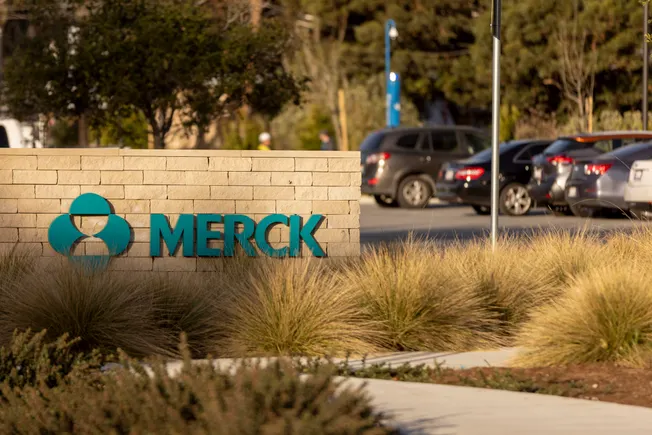

Merck & Co.’s $10 billion acquisition of Verona Pharma Wednesday is a dramatic outcome for a company that’s spent 20 years developing a respiratory drug it now sells as Ohtuvayre. The treatment has been in testing so long its principal patent expired before former President Joe Biden took office.
If Merck and Wall Street’s forecasts of blockbuster sales for Ohtuvayre prove accurate, the drug will be yet another demonstration of how aggressive patenting can help drugmakers turn compounds invented long ago into billions of dollars in revenue.
Ohtuvayre won U.S. approval in 2024, becoming the first new kind of inhaled treatment for chronic obstructive pulmonary disorder in decades. The drug helps people with the lung disorder breathe more freely by relaxing airway muscles and reducing inflammation. Sales have ramped quickly, reaching $71 million in the first quarter, and analysts expect Ohtuvayre could eventually bring in as much as $4 billion a year.
To reach such heights, Merck will need to defend and expand the intellectual property protecting Ohtuvayre. On a Wednesday call, CEO Robert Davis said Merck is “very confident in our ability to protect out to the mid-2030s.”
If Davis and his executive team are right, Ohtuvayre won’t face competition until some three decades after its main compound was initially patented in 2003 in Europe. Ohtuvayre was originally owned by a British company called Ligand UK Development, which had been investigating blocking enzymes called PDE3 and PDE4. In 2006, Verona acquired rights to that intellectual property when it bought Ligand’s partner Rhinopharma. At that point, published data for RPL554 — as the drug was then known — consisted of a study in guinea pigs. The first human trial data was not published until 2013, from early studies that began in 2009.
On Ohtuvayre’s long road to market, Verona shifted from a U.K. stock listing to the U.S. and hit a setback in Phase 2 testing, all while raising money through multiple rounds of borrowing and share sales. Its first Phase 3 data read out in 2022 and the company asked the Food and Drug Administration to approve it one year later.
In the time from RPL554’s invention to Ohtuvayre’s approval, the drug’s main “composition of matter” patent, which describes its chemical makeup, lapsed in 2020. Composition patents are typically the strongest intellectual property that companies can wield in defending against competitor challenges. Other patents can cover a drug’s formulation, manufacturing or methods of use.
Inhaled respiratory drugs like Ohtuvayre are often paired with devices optimized for those medicines, such as with GSK’s Advair or its newer Breo Ellipta. These devices can also be patented and help protect drugs from generic competition. However, Ohtuvayre uses a standard device called a “jet nebulizer” that turns liquid medicines into an inhalable mist, limiting that strategy for expanding its intellectual property protection.
The FDA’s Orange Book database, which lists patents that bar entry of generic medicines, identifies four for Ohtuvayre. Three expire in 2031 and 2035, and the fourth goes to 2044. The focus of Wall Street analysts, as well as Merck executives, is a formulation patent expiring in the mid-2030s that covers technology needed to keep the drug’s liquid suspension stable in different temperatures.
“We spent significant time and diligence understanding all of the different approaches to how you could produce [a generic], whether or not there would be workarounds around the patents and the technical challenges that it would require,” Davis said in the conference call. “We are quite confident the technical challenges of producing around the [formulation] patent are very high.”
Evercore ISI analyst Umer Raffat wrote in a client note that such a patent, which for Ohtuvarye covers a specific “polymorph,” or crystalline, structure of the drug’s core molecule, is “generally not the strongest … for a branded molecule.” However, he added that the need for drug stability in an inhaled medicine is greater than in other types.
Even if generic challengers successfully invalidate all patents after 2031, the deal might not be a bad one for Merck, Raffat wrote. At $4 billion in peak revenue, keeping the branded Ohtuvayre monopoly through 2032 “makes the deal a breakeven,” he wrote.
For Merck, revenue from Ohtuvayre would help offset at least some of the financial losses when patents for Keytruda, its top-selling cancer immunotherapy, expire later this decade. Concerns about Merck’s post-Keytruda future have caused a double-digit share slide this year, and Ohtuvayre adds “diversification away from Keytruda,” wrote Jefferies analyst Akash Tewari in a separate investor note.
Meanwhile, research Verona already has underway could help extend the Ohtuvayre life cycle beyond existing patents. The company is studying in Phase 2 trials preparations for dry powder and pressurized “metered dose” inhalers, which could allow it to establish additional formulation or device patents.